Hon Hai Research Institute Demonstrates Semiconductor Prowess Again! Awarded Oral Presentation at ISPSD 2026, Leading Compound Semiconductors into a New Era of Smart Integrated Circuits
Hon Hai Research Institute Demonstrates Semiconductor Prowess Again! Awarded Oral Presentation at ISPSD 2026, Leading Compound Semiconductors into a New Era of Smart Integrated Circuits
Hon Hai Research Institute's Semiconductor Research Center (HHRI SRC), under the umbrella of Hon Hai Technology Group (Foxconn, TWSE: 2317)—the world's leading electronic manufacturing services provider—has achieved groundbreaking technical advancements in the field of power semiconductors. The center has simultaneously published four high-quality research papers at two of the industry’s most prestigious flagship international conferences in 2026: IEEE ISPSD (the Olympics of the power device community) and IEEE IRPS (the premier forum for reliability physics).
Most notably, HHRI not only continues to lead in technical specifications for Silicon Carbide (SiC) devices but also stood out in the fiercely competitive selection process for Oral Presentations at this year's ISPSD. It is one of only two papers from Taiwan selected for an oral presentation this year. This recognition not only validates the depth of Hon Hai's R&D capabilities but also signifies that its technological influence has officially joined the ranks of the global elite.
Shifting Paradigms: From "Device Optimization" to "Smart System Integration"
Past research in compound power semiconductors has largely focused on optimizing the structures or enhancing the performance of discrete devices. This year, however, HHRI SRC showcased cross-disciplinary technological innovation by successfully shifting its R&D focus from individual device improvement to Smart System Integration.
The team has consecutively published various monolithic integrated circuits (ICs) on the SiC platform. They have not only overcome the highly complex process integration challenges that arise when combining high-voltage power devices with low-voltage control circuits, but they have also guided SiC power devices into a new epoch of intelligence and system-level integration. This opens up a brand-new frontier for SiC material applications. These smart power ICs can be widely deployed in high-power, high-efficiency sectors such as Electric Vehicles (EVs), AI Data Centers, and Robotics, providing the critical core technology for future green energy transition and intelligent computing.
Technical Breakthrough: The World’s First Monolithic Integration of 1.7 kV SiC TCOX UMOSFET and Tri-Gate CMOS
As the centerpiece of this year's ISPSD presentation, the research team led by Dr. Hao-Chung Kuo (Director of HHRI SRC), Yi-Kai Hsiao (Section Chief), and Chia-Lung Hung (Researcher), in collaboration with the research teams of Prof. Bing-Yue Tsui and Prof. Tian-Li Wu from National Yang Ming Chiao Tung University (NYCU), successfully presented a monolithic integration technology combining a 1.7 kV SiC TCOX UMOSFET with Tri-Gate CMOS.
This pioneering research marks the first time a CMOS circuit utilizing a three-sided gate structure (Tri-Gate) has been monolithically integrated right next to a high-voltage trench-type power device, thoroughly solving the process integration hurdles where high- and low-voltage devices must coexist.
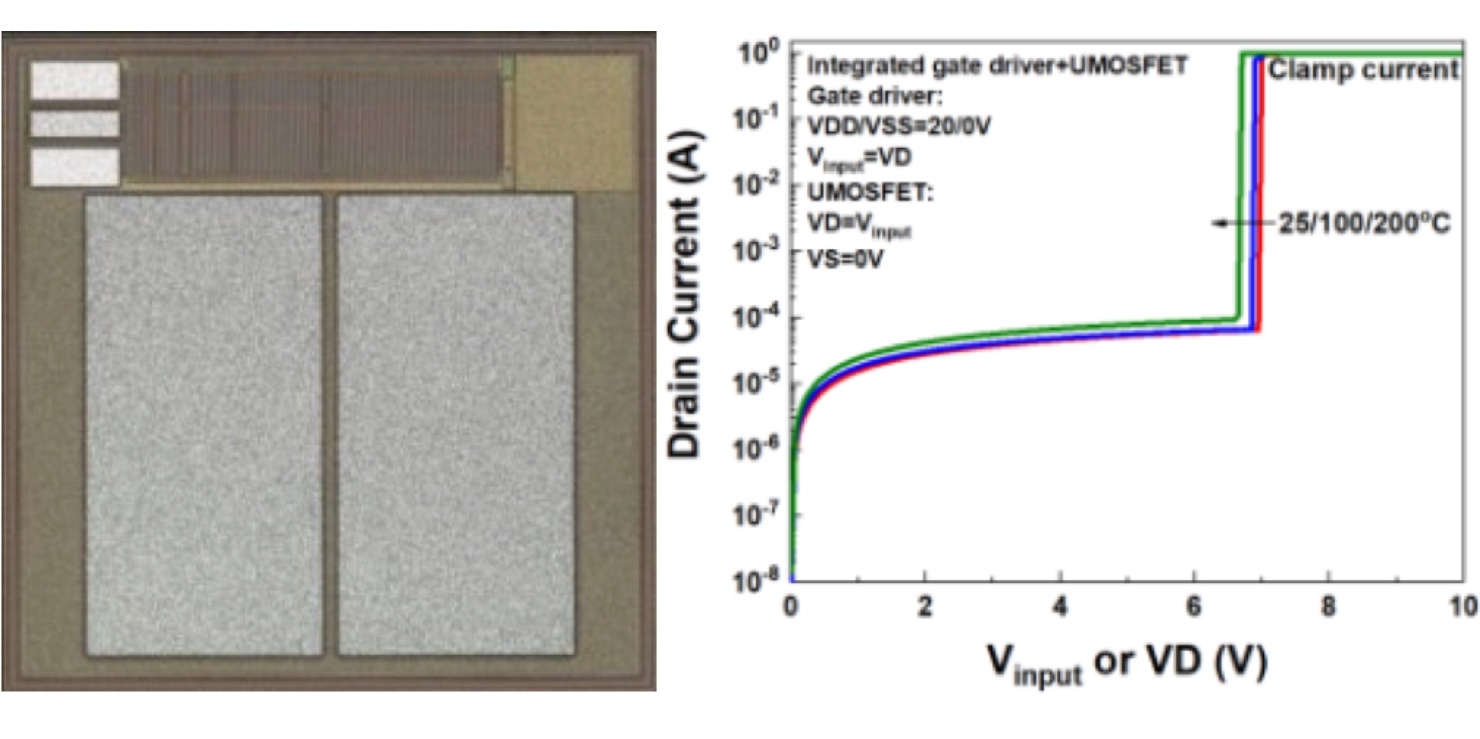
Experimental data reveals that this innovative structure successfully adjusts the low-voltage Tri-Gate FET to a suitable threshold voltage while maintaining the excellent characteristics of the high-voltage devices. This significantly boosts computing speed and minimizes static power consumption. Furthermore, the circuit is capable of operating at an elevated temperature of 200°C, offering a tremendous advantage for the high-temperature environments of next-generation data centers. Concurrently, the team has successfully verified core circuit building blocks on this platform, including Operational Amplifiers (OPAMPs), Memory (6T-SRAM), and Gate Drivers, laying a rock-solid foundation for the future technological evolution and commercialization of "Smart Power ICs."
Unveiling Reliability Physics Mechanisms to Power High-Reliability Applications
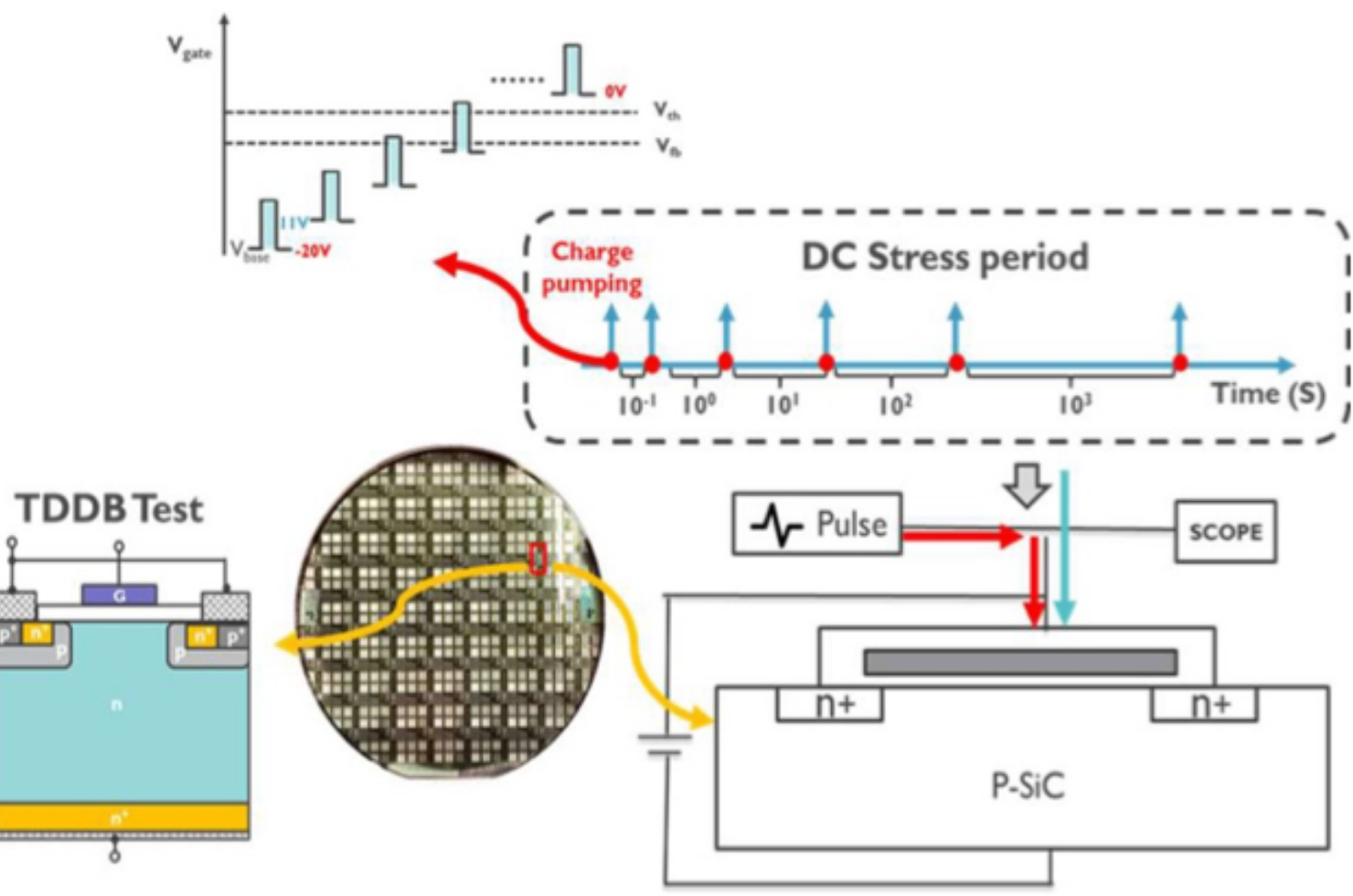
In terms of device stability and lifetime prediction, HHRI, together with Prof. Tian-Li Wu’s research team at NYCU, also presented long-term research findings on the reliability physics mechanisms of 4H-SiC MOSFETs at the IEEE IRPS conference.
Using the Charge Pumping technique for quantitative analysis, the researchers demonstrated that under long-term stress, the dominant failure mechanism of the device shifts from early-stage "hole trapping" to "electron trapping." They also confirmed that elevated temperatures severely accelerate the generation of interface traps, ultimately causing gate current degradation. This milestone achievement is paramount for lifetime evaluation in high-reliability scenarios such as EVs and renewable energy systems.
Comprehensive Layout: From GaN Sensors to High-Voltage Power Devices
In addition to the two aforementioned milestones, HHRI has demonstrated its comprehensive R&D layout across high-voltage applications. This includes:
1.7 kV JBSFET: Developed with Prof. Bing-Yue Tsui and Prof. Thien-Chiu Wu’s teams at NYCU, achieving an ultra-low specific on-resistance (2.96mΩ-cm2) and stable high-temperature operation at 200°C.
"Bowtie" Structure GaN HEMT: A novel architecture proposed for high-voltage GaN sensing applications. This structure effectively suppresses the channel length modulation effect, drastically boosting the 3dB bandwidth from 21 kHz to 113 kHz.
Through a comprehensive suite of R&D achievements—spanning device structure innovation, monolithic IC integration, and advanced reliability analysis—Hon Hai Research Institute not only strengthens the core competitiveness of the Group's "3+3+3" development strategy but also continues to inject robust momentum into the global smart power semiconductor market through technology transfer and industry-academia collaboration.