🌟 Hon Hai Research Institute Quantum Computing Center Shines at AQIS 2026
🌟 Hon Hai Research Institute Quantum Computing Center Shines at AQIS 2026
Post Date
September 2, 2026
Centers
Topic
At the 26th Asian Quantum Information Science Conference (AQIS 2026) held at KAIST in Daejeon, South Korea, the Hon Hai Quantum Computing Research Center (HHQC) showcased a wealth of research achievements, highlighted by one plenary talk, two regular oral presentations, and a prestigious poster award.
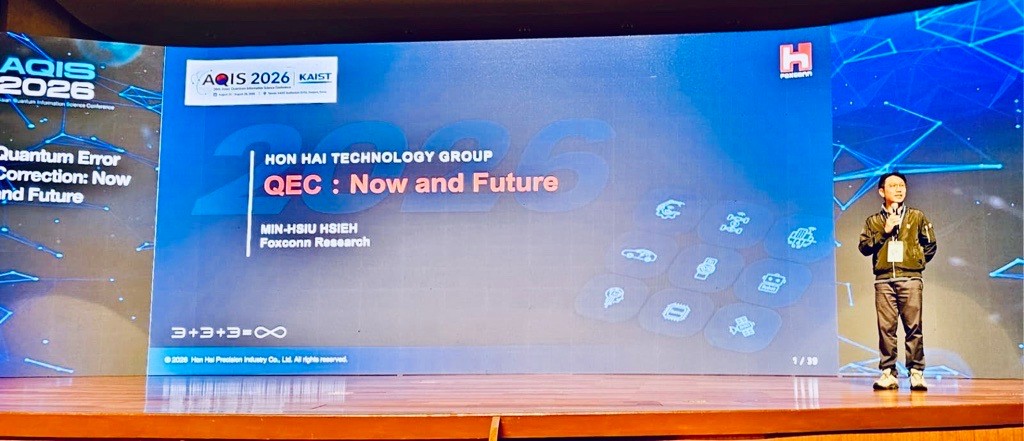
🏛️ Director Min-Hsiu Hsieh Delivers Plenary Talk: Charting the Present and Future of Quantum Error Correction
Director Min-Hsiu Hsieh was invited to deliver a Plenary Talk titled "Quantum Error Correction: Now and Future." The lecture comprehensively examined the key bottlenecks in encoding and decoding efficiency when building large-scale fault-tolerant quantum computers. It also presented forward-looking perspectives on reducing hardware overhead and implementing low-latency decoding architectures, charting critical directions for the realization of practical fault-tolerant quantum technologies.
🎓 Regular Oral Presentation: Hybrid Quantization Scheme Significantly Optimizes Quantum Chemistry Simulations
During the regular oral sessions, Director Min-Hsiu Hsieh presented the research titled "Optimizing Quantum Chemistry Simulations with a Hybrid Quantization Scheme". This work was jointly conducted by HHQC researchers Calvin Ku and Yu-Cheng Chen, Director Min-Hsiu Hsieh, and Prof. Alice Hu from the City University of Hong Kong:
Overcoming Wavefunction Representation Barriers: The team proposed a conversion circuit with a gate cost of O(N log N log M) (Theorem 1), successfully bridging the first-quantized encoding and the second-quantized "sorted-list encoding," while expanding single-particle basis transformations within first quantization (Corollary 1).
Substantial Reduction in Computational Resources: Demonstrating polynomial improvements across workflows such as ab-initio molecular dynamics (BO-AIMD), spectroscopic Green's function calculations, and k-RDM measurements via classical shadows, the framework achieves up to a three-orders-of-magnitude reduction in the number of state preparations required when measuring 2-RDMs for specific molecular systems.
🔒 Regular Oral Presentation: Investigating the Hardness of Quantum Distribution Learning and Quantum Cryptography
HHQC Researcher Taiga Hirooka delivered a regular oral talk titled "Hardness of Quantum Distribution Learning and Quantum Cryptography." Co-authored by Taiga Hirooka, Director Min-Hsiu Hsieh, and Prof. Tomoyuki Morimae from Kyoto University, the study deeply investigates the computational complexity boundaries of quantum distribution learning and establishes profound connections to the security of quantum cryptography, providing pivotal theoretical insights for assessing the computational limits of quantum algorithms and post-quantum cryptographic frameworks.
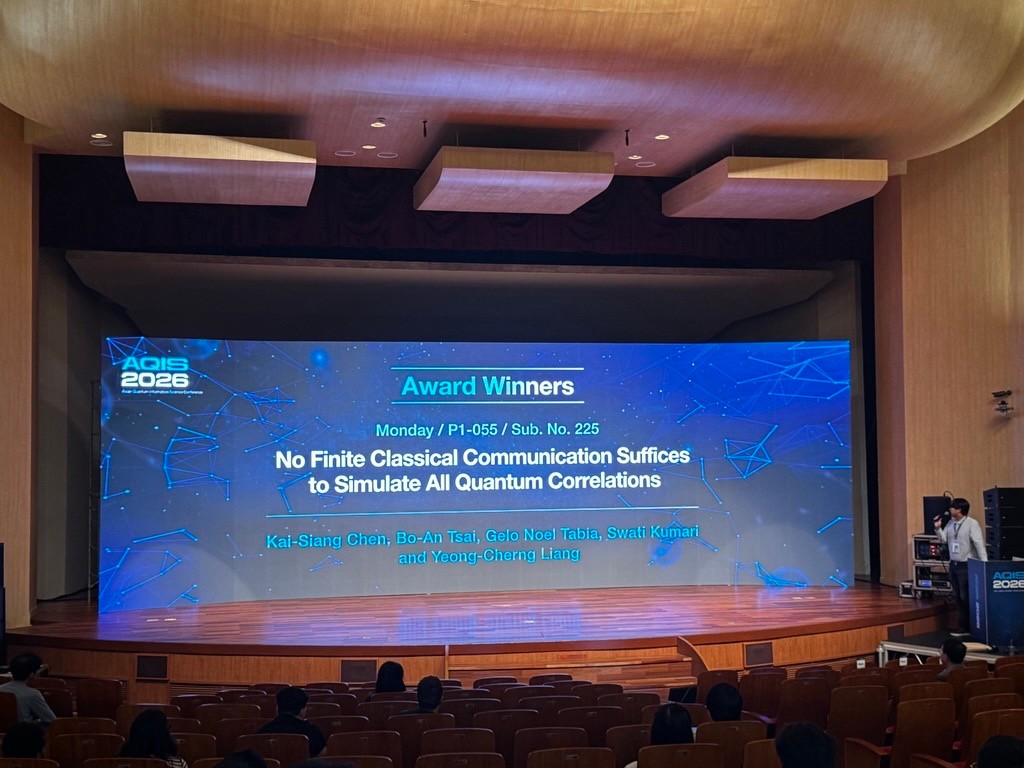
🏆 Collaborative Poster Wins Award
In the poster sessions, the collaborative paper "No Finite Classical Communication Suffices to Simulate All Quantum Correlations" (authored by Kai-Siang Chen, Bo-An Tsai, Gelo Noel Tabia, Swati Kumari, and Yeong-Cherng Liang)——a joint work between researchers from the Hon Hai Research Institute, National Cheng Kung University, and Patna University, India——stood out among numerous competitive submissions and won the conference award (Award Winners). The research provides a rigorous theoretical characterization of the communication resources required to simulate quantum correlations, proving that no finite amount of classical communication suffices to fully simulate all quantum correlations, thereby making a significant contribution to foundational quantum nonlocality theory.
🤝 Deepening Foundational Theory and Global Collaboration to Drive Frontier Innovation
Ranging from quantum error correction and quantum simulation algorithms to foundational quantum theory and cryptography, HHQC's comprehensive presence at AQIS 2026 underscores the institute's strong R&D momentum and the success of its international collaborative initiatives. The Hon Hai Quantum Computing Research Center will continue partnering with the global academic community to advance key frontiers in fault-tolerant quantum computing, laying a solid foundation for next-generation technologies.
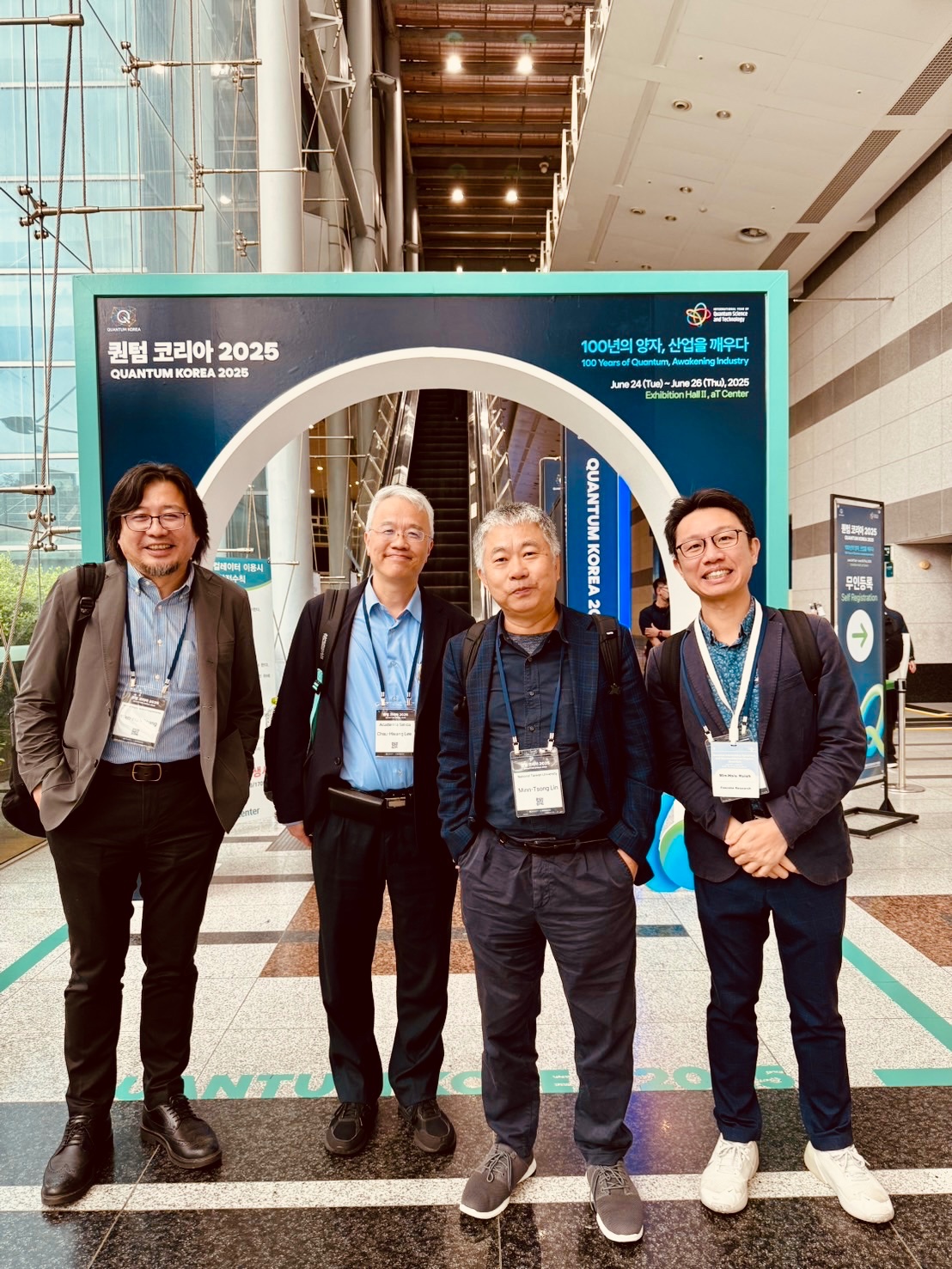
Director Min-Hsiu Hsieh Attends Quantum Korea 2025 with Taiwan Delegation, Showcasing Taiwan’s Quantum Strength
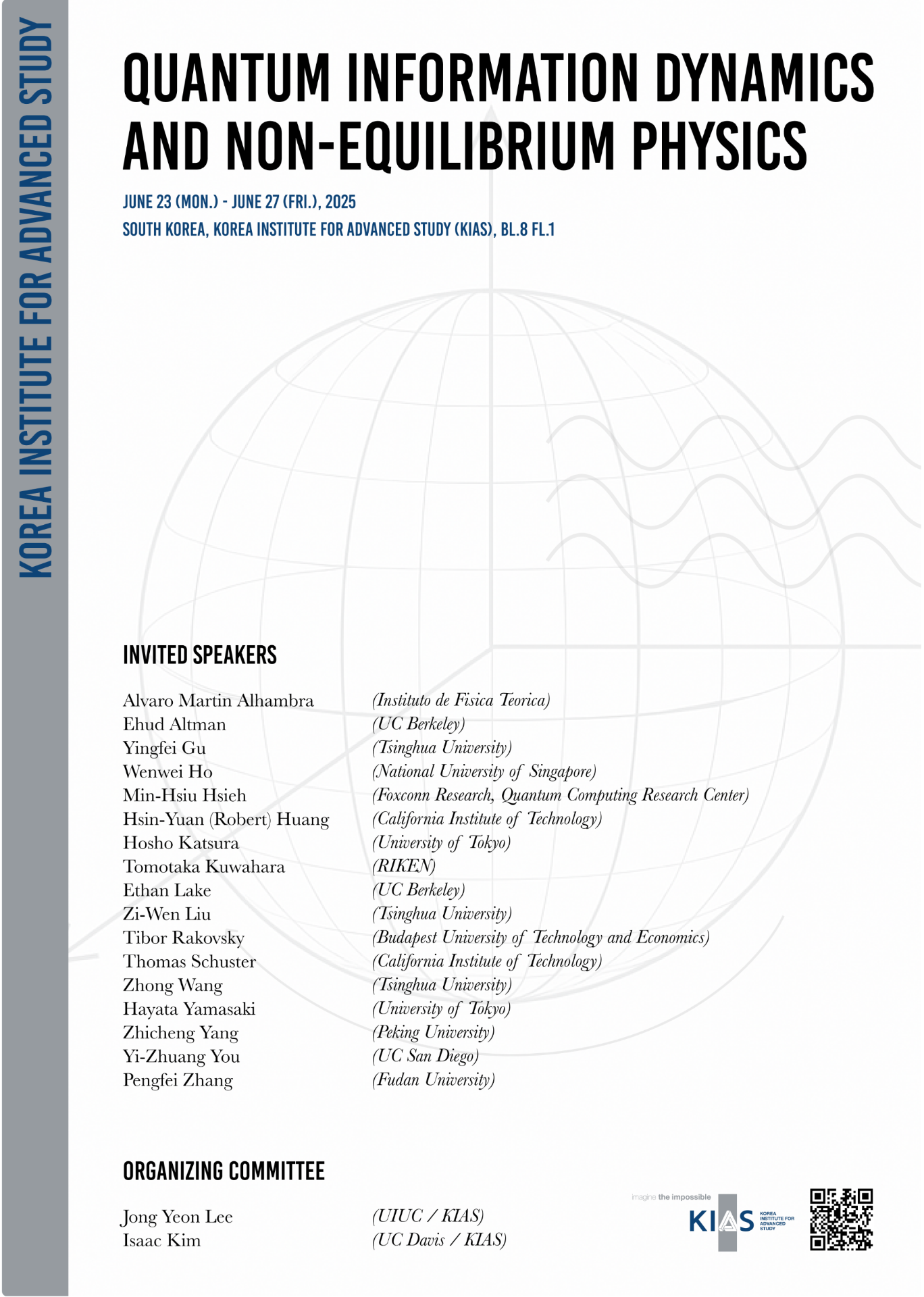
Director Hsieh was invited to attend the international academic conference Quantum Information Dynamics and Non-Equilibrium Physics 2025, held at KIAS (Korea Institute for Advanced Study) in Seoul.
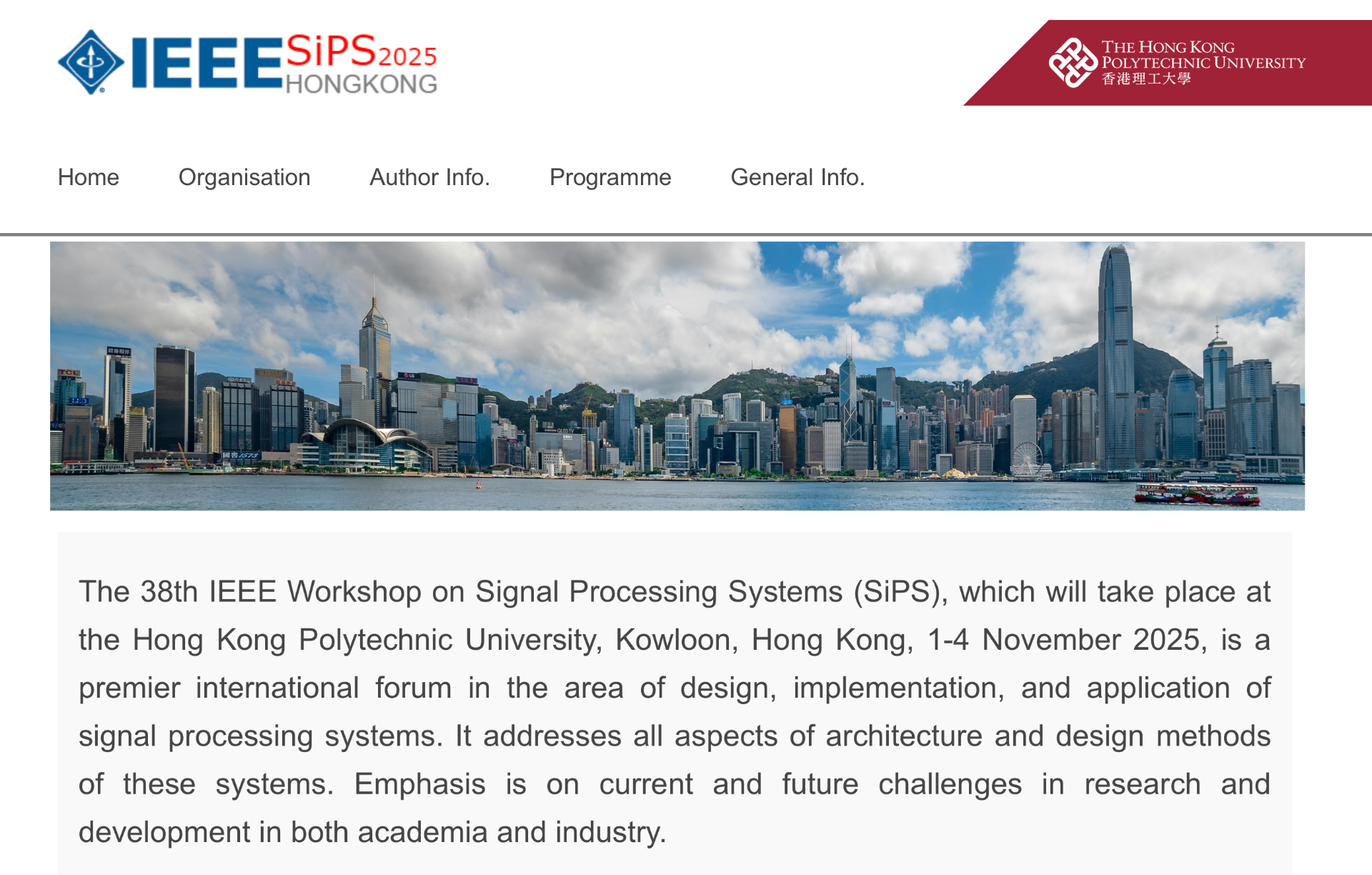
Hon Hai Research Institute Director Invited to IEEE SiPS 2025 Technical Program Committee