Hon Hai Quantum Computing Research Center Achieves Significant Research Advance Accepted by ASIACRYPT 2026: Taiga Hiroka Appointed to Program Committee
Hon Hai Quantum Computing Research Center Achieves Significant Research Advance Accepted by ASIACRYPT 2026: Taiga Hiroka Appointed to Program Committee
Post Date
September 23, 2026
Centers
Topic

The Hon Hai Quantum Computing Research Center (HHQC) has achieved another significant international milestone in the field of quantum cryptography. A collaborative paper titled Hardness of Quantum Distribution Learning and Quantum Cryptography, jointly conducted by researcher Taiga Hiroka, Center Director Min-Hsiu Hsieh, and HHRI consultant Professor Tomoyuki Morimae from Kyoto University, has been officially accepted by ASIACRYPT 2026, one of the premier flagship conferences in cryptography. Furthermore, Taiga Hiroka has been invited to serve as the Program Committee of ASIACRYPT 2026, highlighting the research center's academic standing and growing impact within the global cryptographic community.
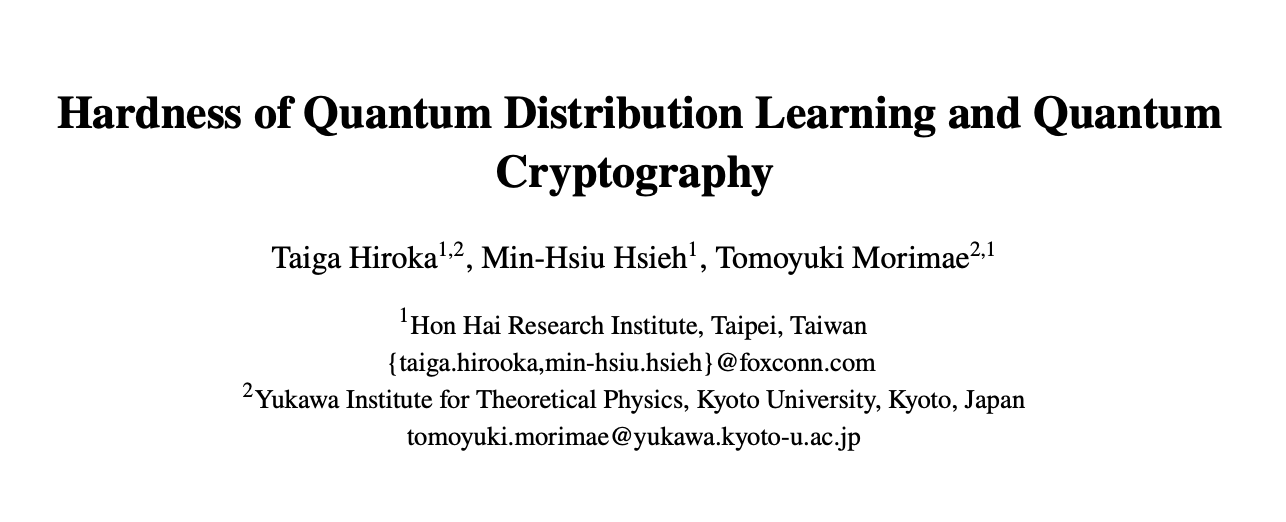
🔒 Computational Complexity of Quantum Distribution Learning and the Foundations of Quantum Cryptography
In classical cryptography, the existence of One-Way Functions (OWFs) serves as the cornerstone for building secure cryptographic primitives, while establishing OWFs from P != NP remains a central open problem in complexity theory, classically characterized through the hardness of learning. In quantum cryptography, however, OWFs are not necessarily the minimal assumption; One-Way Puzzles (OWPuzzs), their natural quantum analogue, have lacked an analogous learning-theoretic characterization.
This study provides the first complete equivalence characterization between quantum one-way puzzles and computational learning theory:
Equivalence Between Quantum One-Way Puzzles and Distribution Learning: The team demonstrated that the existence of OWPuzzs is equivalent to the average-case hardness of proper quantum distribution learning.
Separation and Hardness Barriers: Investigating whether quantum one-way puzzles can be based on PP != BQP, the researchers showed that establishing worst-case PP-hardness of proper quantum distribution learning via black-box reductions would imply SampBQP != SampBPP under the assumption that the polynomial-time hierarchy is infinite, thereby identifying a formal barrier to this question.
Worst-Case Based Quantum Advantage: The team revealed that the hardness of agnostic quantum distribution learning with respect to statistical distance directly implies SampBQP != SampBPP. This represents the first construction of a sampling-based quantum advantage derived entirely from a worst-case hardness assumption in distribution learning.
🏛️ Contributing to International Peer Review and Deepening Global Academic Impact
ASIACRYPT is one of the three flagship conferences organized by the International Association for Cryptologic Research (IACR), alongside CRYPTO and EUROCRYPT, representing the highest academic standard in cryptography and theoretical information security. In addition to producing impactful theoretical contributions across quantum cryptography and meta-complexity, Taiga Hiroka's invitation to serve on the ASIACRYPT 2026 Program Committee underscores the peer recognition of HHQC's specialized expertise within the international cryptographic community.
🤝 Advancing Fundamental Theory and International Research Collaborations
The Hon Hai Quantum Computing Research Center continues to collaborate with leading academic institutions and global partners to advance foundational research across quantum algorithms, quantum cryptography, and post-quantum security frameworks. Through rigorous theoretical investigation and sustained international engagement, the center remains dedicated to laying the scientific groundwork for next-generation secure quantum technologies, fostering advanced scientific talent, and driving meaningful practical progress in quantum computing.
More information:
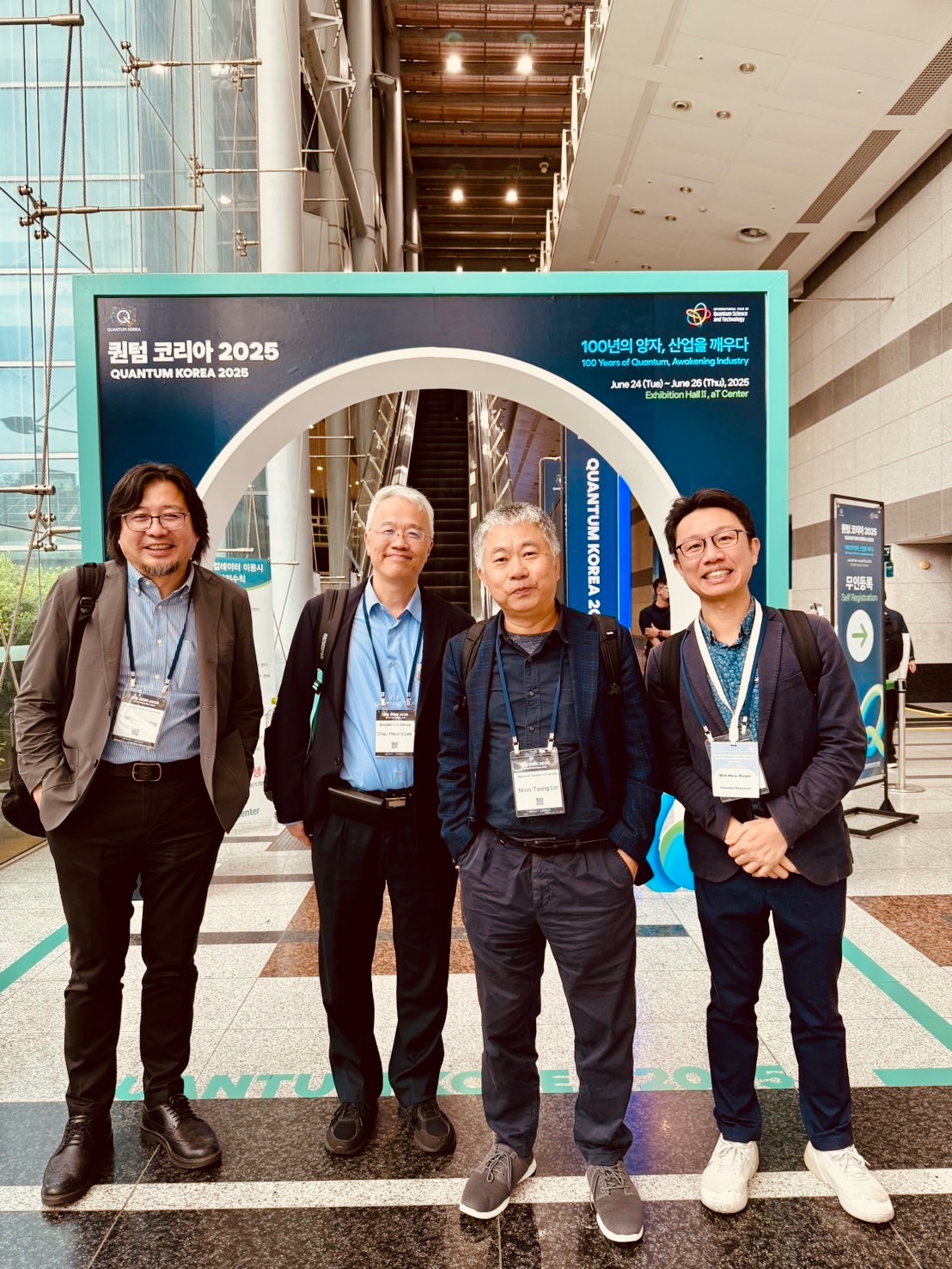
Director Min-Hsiu Hsieh Attends Quantum Korea 2025 with Taiwan Delegation, Showcasing Taiwan’s Quantum Strength
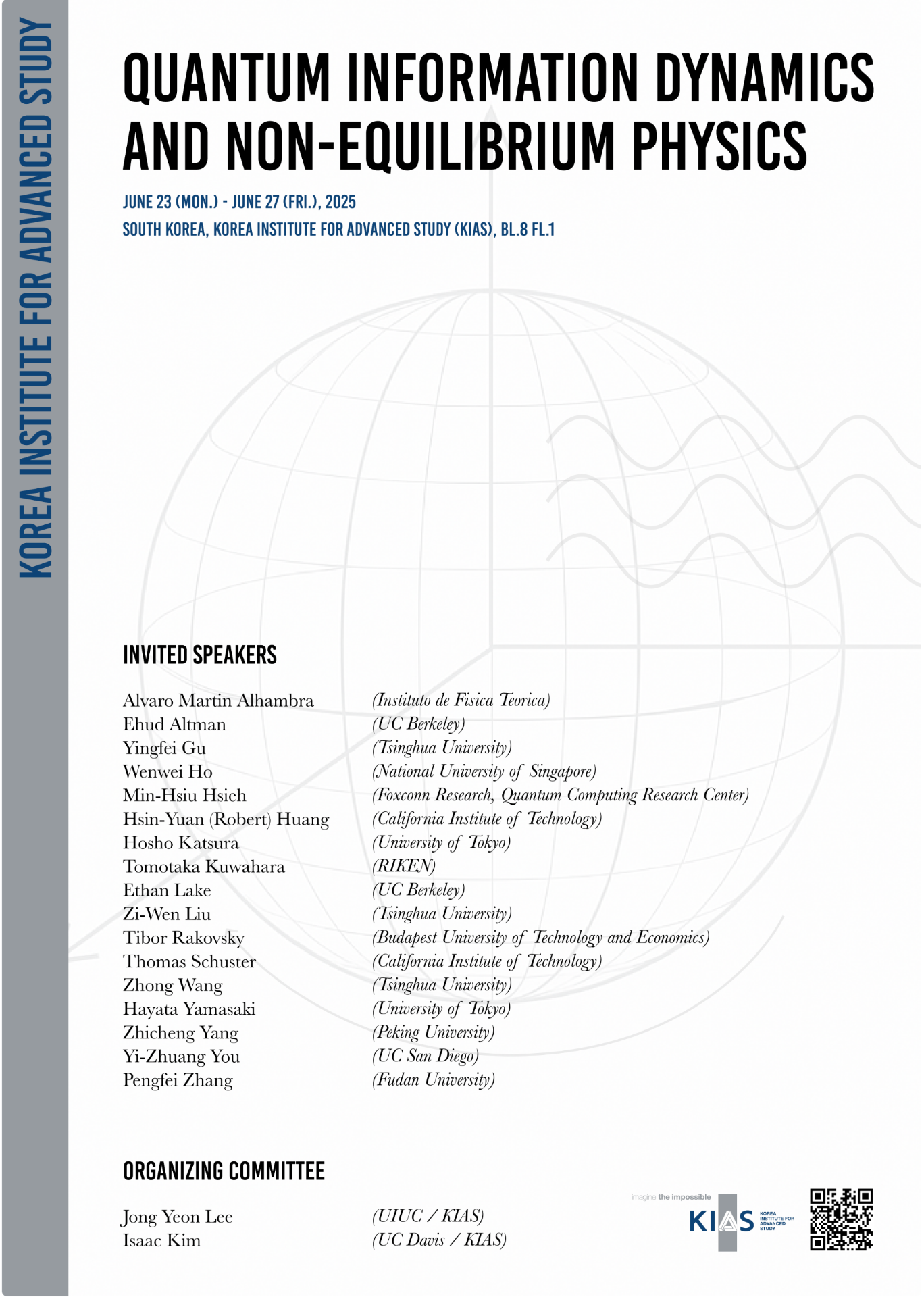
Director Hsieh was invited to attend the international academic conference Quantum Information Dynamics and Non-Equilibrium Physics 2025, held at KIAS (Korea Institute for Advanced Study) in Seoul.
Hon Hai Research Institute Director Invited to IEEE SiPS 2025 Technical Program Committee