Quantum Research Center Popular Science Talk:A story in computation
Quantum Research Center Popular Science Talk:A story in computation
Post Date
June 3, 2026
Centers
Topic
Speaker: Dr. Hakop Pashayan
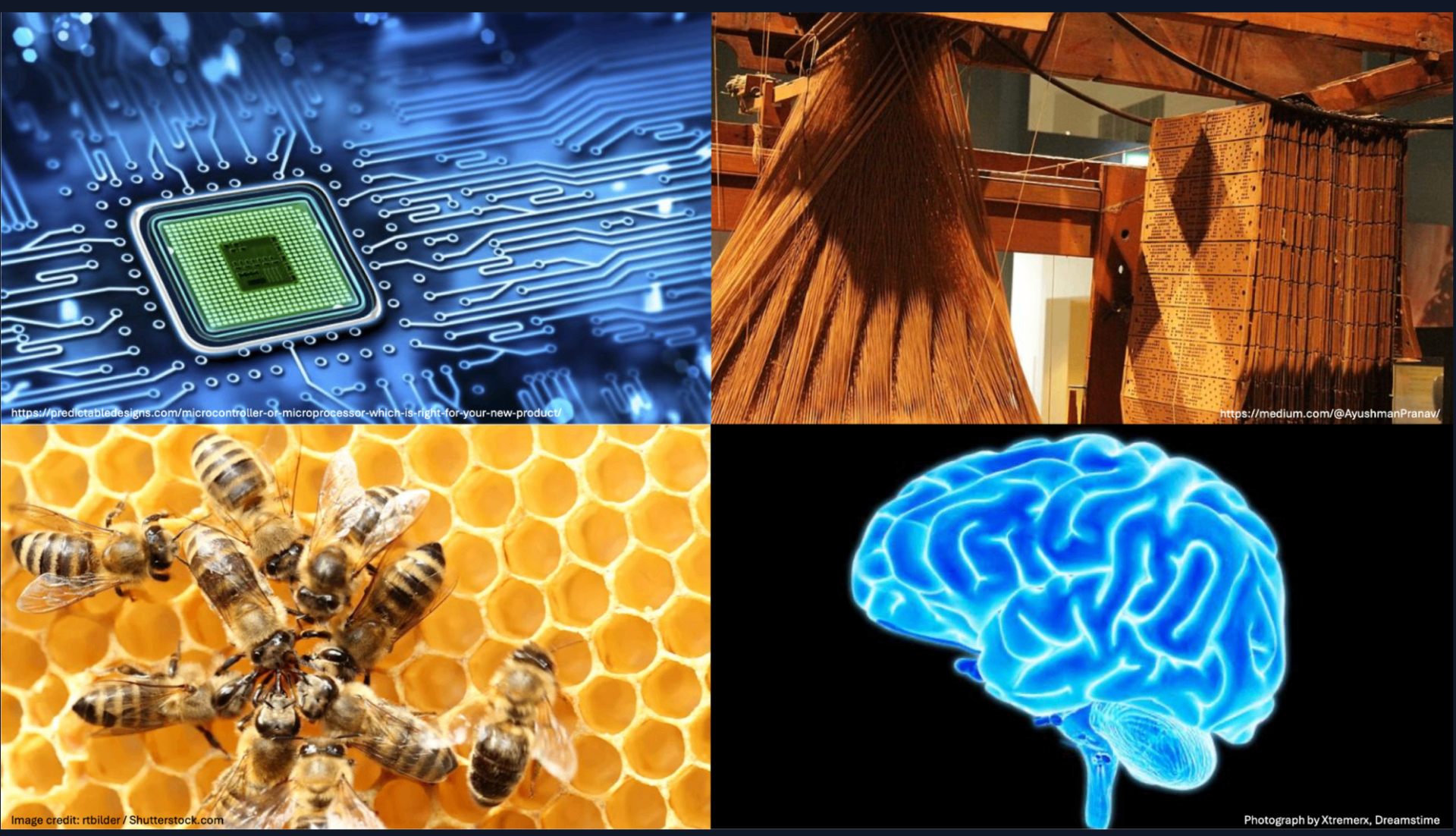
When we think of computation, we usually picture servers humming in massive
data centers or the silicon chips embedded in our smartphones. We view
computation as a purely human engineering endeavor—a tool we built to
manipulate numbers and render graphics. But this view is fundamentally
incomplete. Computation is not just an invention; it is a universal process woven
into the very fabric of nature.
In a recent exploration of the "Physics of Information," we are invited to radically
shift our perspective. To truly understand the frontier of modern technology—
specifically, the enigma of quantum computing—we must take a journey that
begins with abstract mathematics, collides with the harsh limits of logic, and
ultimately reveals that the rules of computation are rigidly dictated by the laws of
physics.
The Illusion of Mathematics
At its absolute core, computation is simply data processing. It is the application of
a strict set of rules that maps input information to output information. We are
familiar with basic logical operations, like AND or NOT gates, which can be strung
together to perform addition or multiplication. But these mapping rules can also
take highly geometric, visual forms.
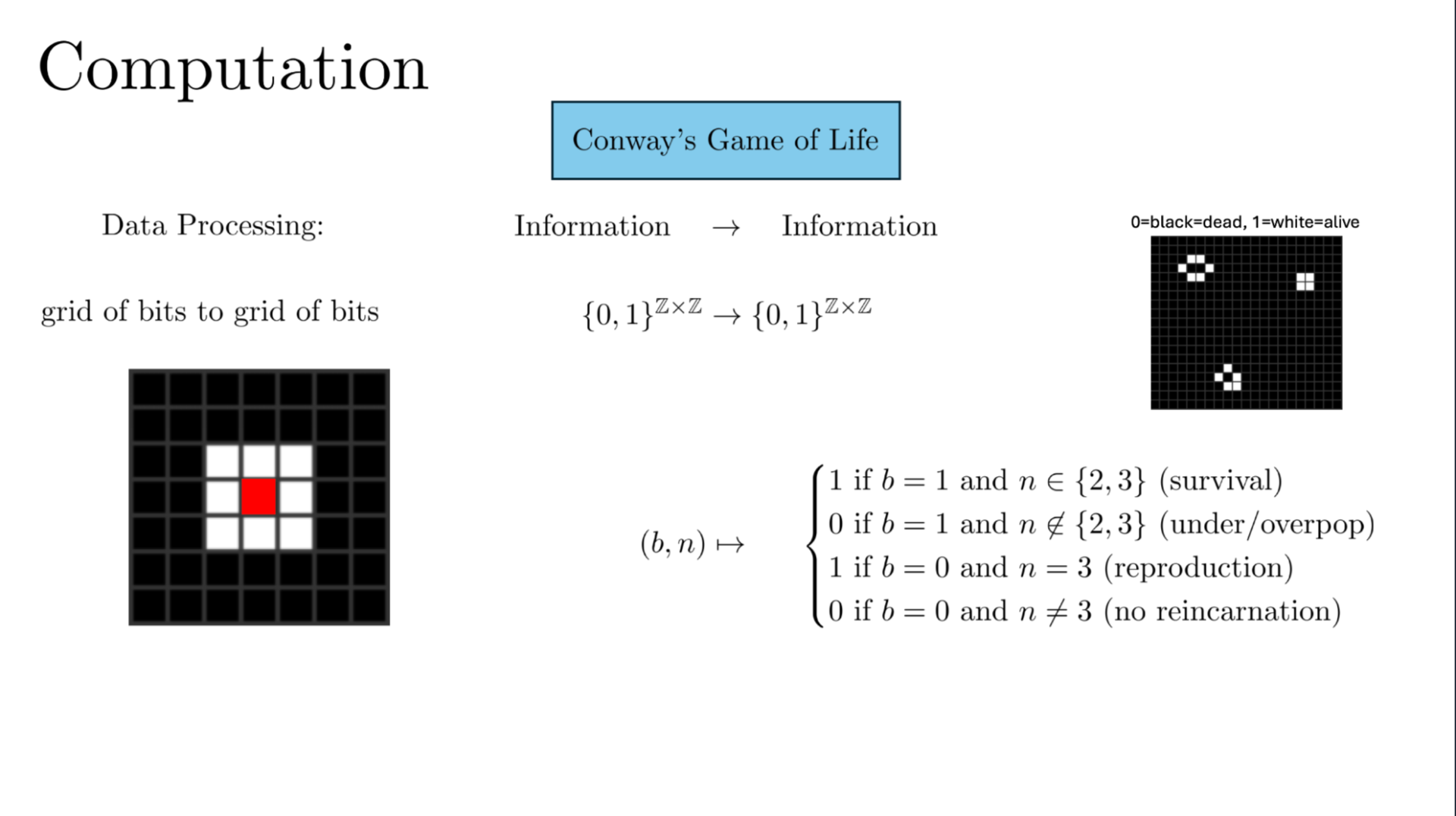
Consider Conway’s Game of Life, a "zero-player game" played on an infinite grid.
Every cell on the grid is either alive (1) or dead (0). The grid updates in discrete
time steps based on an incredibly simple, localized rule: a cell survives if it has two
or three neighbors, dies if it is overcrowded or isolated, and springs to life if it is
surrounded by exactly three living cells.
When you apply these rigid, deterministic rules repeatedly, something profound
happens: emergence. Out of the chaotic flashing of 1s and 0s, stable geometric
structures form. Some structures, called "gliders," actually propel themselves
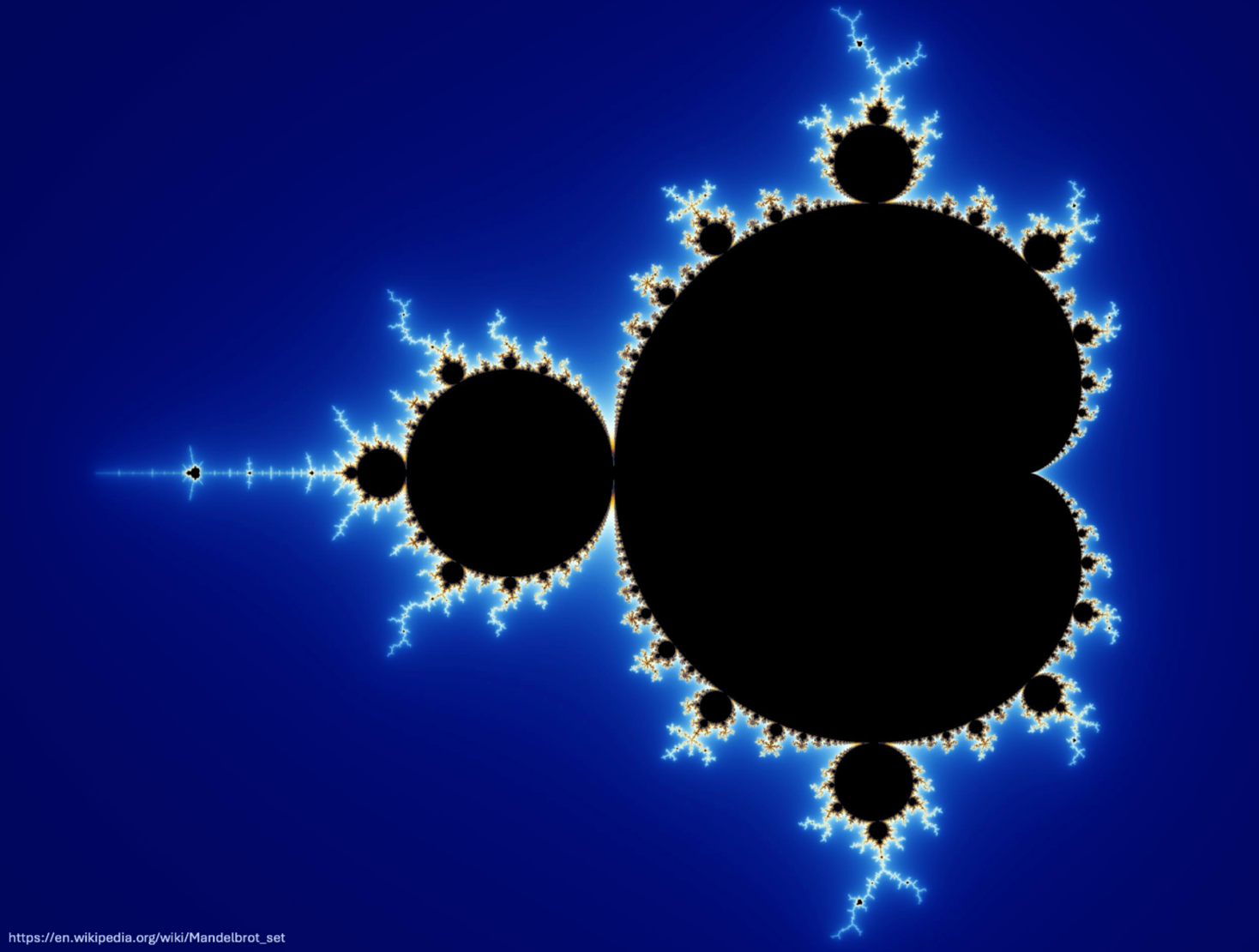
across the grid. We see this same emergence in continuous mathematics. The
famous Mandelbrot set is generated by a deceptively simple iterative equation
($z_{n+1} = z_n^2 + c$). Yet, zooming into the boundary of this set reveals an
infinitely complex, fractal universe born entirely from a single rule.
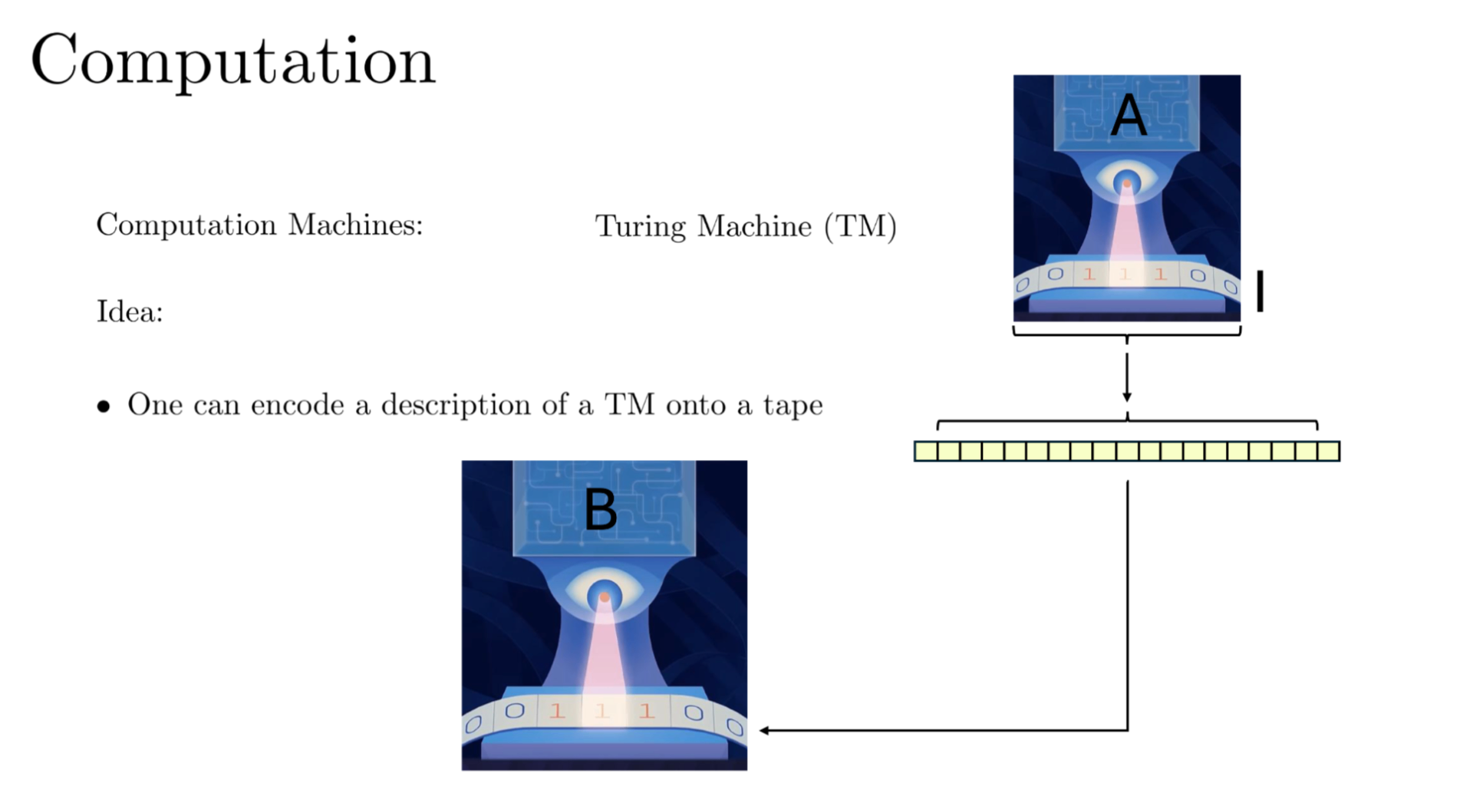
To formalize computation and computing machines, mathematician Alan Turing
introduced the Turing Machine in 1936. It is an abstract device featuring an
infinite tape of 1s and 0s, a read/write head, and a basic list of internal states.
Turing proved that this beautifully simple theoretical machine captures the
absolute essence of computation. In fact, it revealed the principle of universality.
The hardware doesn't actually matter. A standard Turing Machine, a
supercomputer, and even the Conway's Game of Life are in some concrete
mathematically sense equivalent. They can all simulate each other (Turing
complete).
Hitting the Wall: The Limits of Logic
However, this mathematical utopia has boundaries. Since Turing Machines can
compute anything that is computable, we are forced to ask: is there math they
cannot do?
The answer is a resounding yes. The most famous example is the Halting Problem,
which proves it is fundamentally impossible to write a program that can flawlessly
predict whether any other given program will eventually halt or loop forever. This
uncomputability isn't just an abstract paradox; it shows up in simple counting
exercises like the "Busy Beaver" game. If you ask what is the maximum number of
1s an $N$-state Turing Machine can print before halting, the answers for 1, 2, 3,
and 4 states are small, manageable numbers. But by the time you reach $N=6$,
the number is so unfathomably large it dwarfs the number of atoms in the
universe.
For the problems we can compute, we run into a different wall: time and space.
This is the domain of Computational Complexity. We classify problems by how
drastically their difficulty scales as the input size grows. Problems in polynomial
time (P) scale gently, while problems in NP might be exponentially hard to solve
from scratch. Here, we leave the abstract realm of pure logic and are forced to
confront reality. We don't have infinite tape, and we don't have infinite time.
Computation is Physical
This brings us to a crucial pivot in our understanding of information: doing actual
computation requires a physical system subject to physical laws.
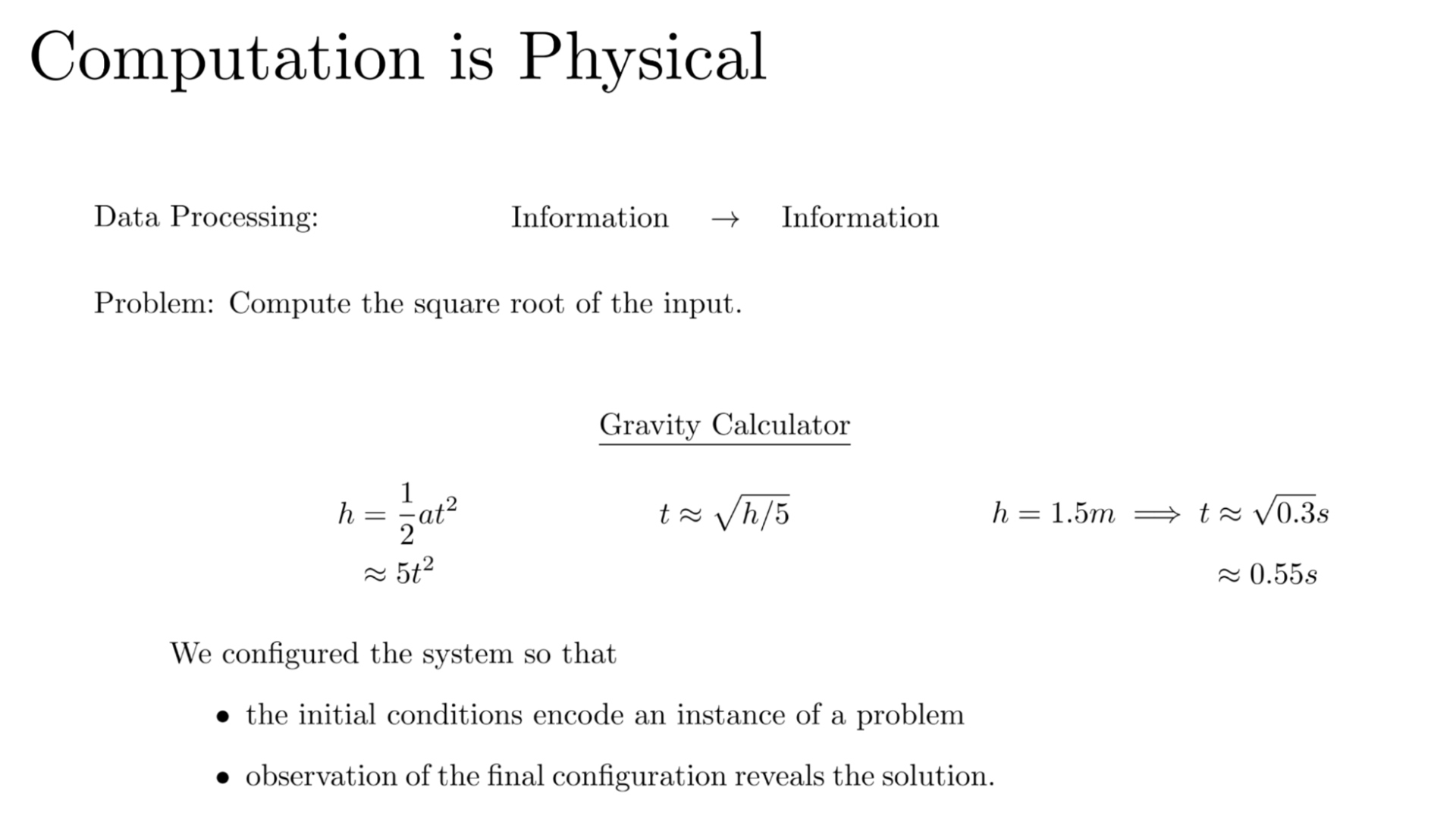
Imagine you need to compute the square root of a number. You don't necessarily
need a microchip. You could simply drop a ball from a specific height $h$ and
measure the time it takes to hit the ground. Because $t = \sqrt{2h/g}$, the
observable outcome of this physical system yields your mathematical answer.
Every computation relies on physics.
Because of this inescapable connection, computer scientists formulated the
Extended Church-Turing Thesis. It essentially argues that classical physics
fundamentally limits computational efficiency. No matter what bizarre classical
physical system you build—whether it's powered by fluid dynamics, gravity, or
complex chemical reactions—it cannot give you an exponential speed shortcut
over a standard Turing Machine. Classical physics dictates the ultimate speed limit
of classical computation.
The Quantum Loophole
But what happens if we build physical computation machines who’s behavior
cannot be well approximated by the classical laws of physics? What if we compute
using quantum mechanics?
A classical bit is a switch, stubbornly restricted to exactly 0 or 1. A single quantum
bit, or qubit, can exist in a state of superposition, holding a complex amplitude for
being 0 and a complex amplitude for being 1. This can be described by a point on
the 2D surface of a 3D sphere. But the true paradigm shift—the curse and blessing
of dimensionality—happens when we scale up.
If you have $n$ classical bits, you just have $n$ pieces of information. But if you
have $n$ entangled qubits, they exist as a single vector in a massive, $2^n$-
dimensional complex space. To simulate just 300 fully entangled qubits, as far as
we can tell, nature keeps track of approximately $2^{300}$ complex numbers—
more numbers than there are atoms in the observable universe. Quantum states
have a physical embodiment, meaning nature handles this unimaginably vast
math for free. The data is encoded in a physical system and we can use
measurement to observe and query this vast data.
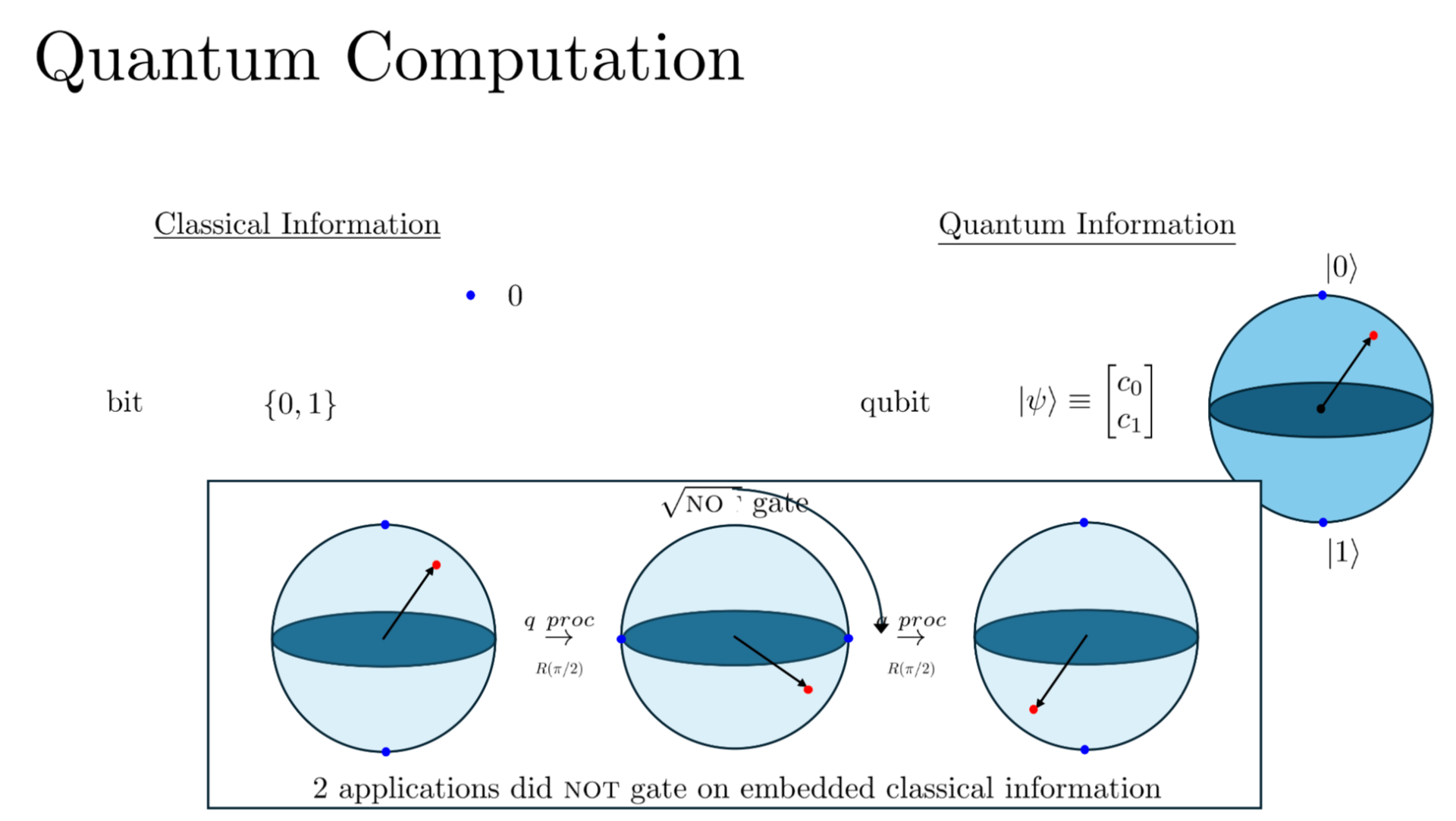
Quantum evolution allows us to navigate this space using operations that have
no classical equivalent. For example, there is a unitary quantum operation that,
when applied twice, results in a perfect NOT gate. Classically, there is no such
thing as a "square root of NOT." Applying it once moves the system into a
computational dimension completely inaccessible to classical logic.
Computation is not just abstract mathematics hovering in the ether. It is physical
data processing. By building machines that operate on the laws of quantum
mechanics, we aren't just building faster calculators; we are unlocking a
completely different physical sandbox. We are finally learning how to compute
with the full fabric of reality.

Building Efficient Algorithms with Error Correction, Clustering, and Noise Mitigation
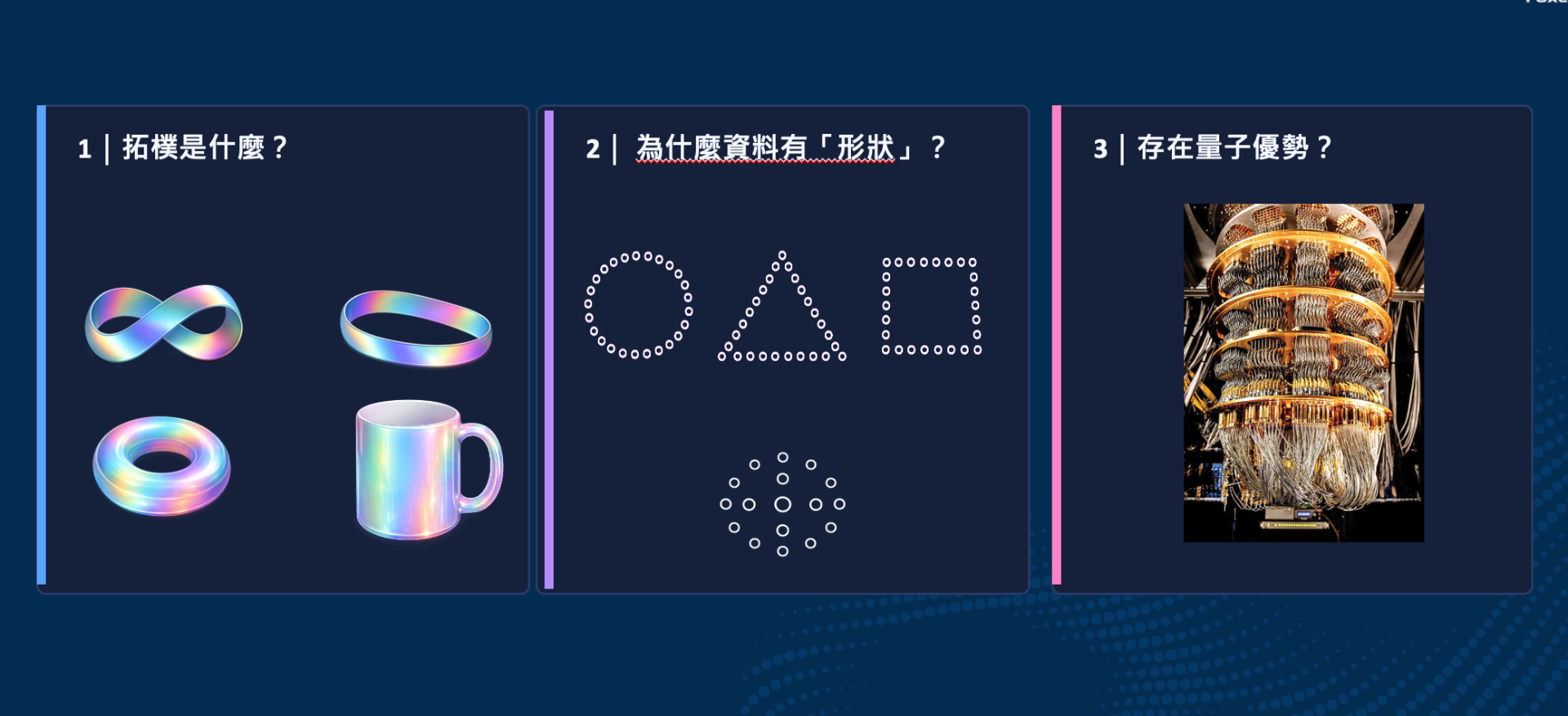
Quantum Research Center Popular Science: The Geometric Contour of Data—From Topological Data Analysis to the Exponential Advantage of Quantum Algorithms
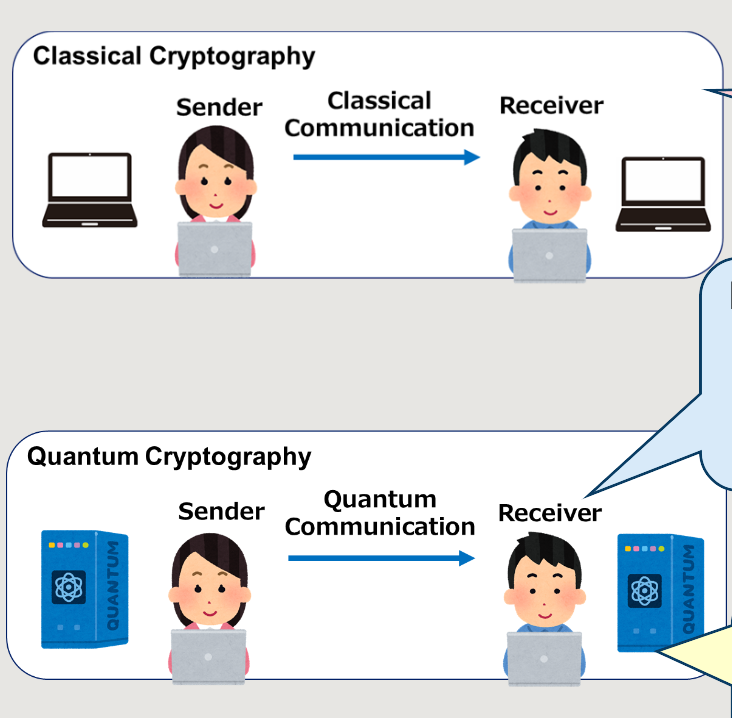
Quantum Research Center Popular Science Talk:Quantum Cryptography with Certified Deletion